

Sculptured Arts Studio
David Vanquishing Goliath Statue
David Vanquishing Goliath Statue
Verfügbarkeit für Abholungen konnte nicht geladen werden
David Vanquishing Goliath
By Marius-jean-AntoninMersie, French, 1845 - 1916.
First modeled in clay 1872, a skilful study of anatomy and realism, Antonin Mercié’s sculpture depicts the aftermath of the biblical shepherd David’s dramatic felling of the giant Goliath with a slingshot. Mercié spent the volatile years surrounding the Franco-Prussian War studying sculpture in Rome. One of the first works he sent back to France was a plaster sculpture of David resheathing his sword after slicing off Goliath’s head. For Parisians encountering this work at the annual spring Salon exhibition, it was a sign of hope for the future: just as David had overcome a more powerful foe, so France would overcome its recent defeat by the Germans.
The sculpture won Mercié a gold medal at the Salon, and the following year he was awarded a Legion of Honor, an extraordinary honor for an art student. The sculpture’s image was widely reproduced in magazines, and the Barbedienne foundry sold bronze versions of it in several sizes.
When he created his David in 1869, Mercié was a resident at the Académie de France in Rome. His ambition was to renew the representation of this biblical episode recounting the victory of the young shepherd in his duel against the giant Goliath. To this end, he placed himself in the tradition of the great bronze sculptors of the Florentine Renaissance, notably Donatello and Verrocchio
Presented at the Salon after the war of 1870, the David was a great success because of the elegance of its pose and the firmness of its modeling, but also as a symbol of hope for a future revenge of France against Prussia.
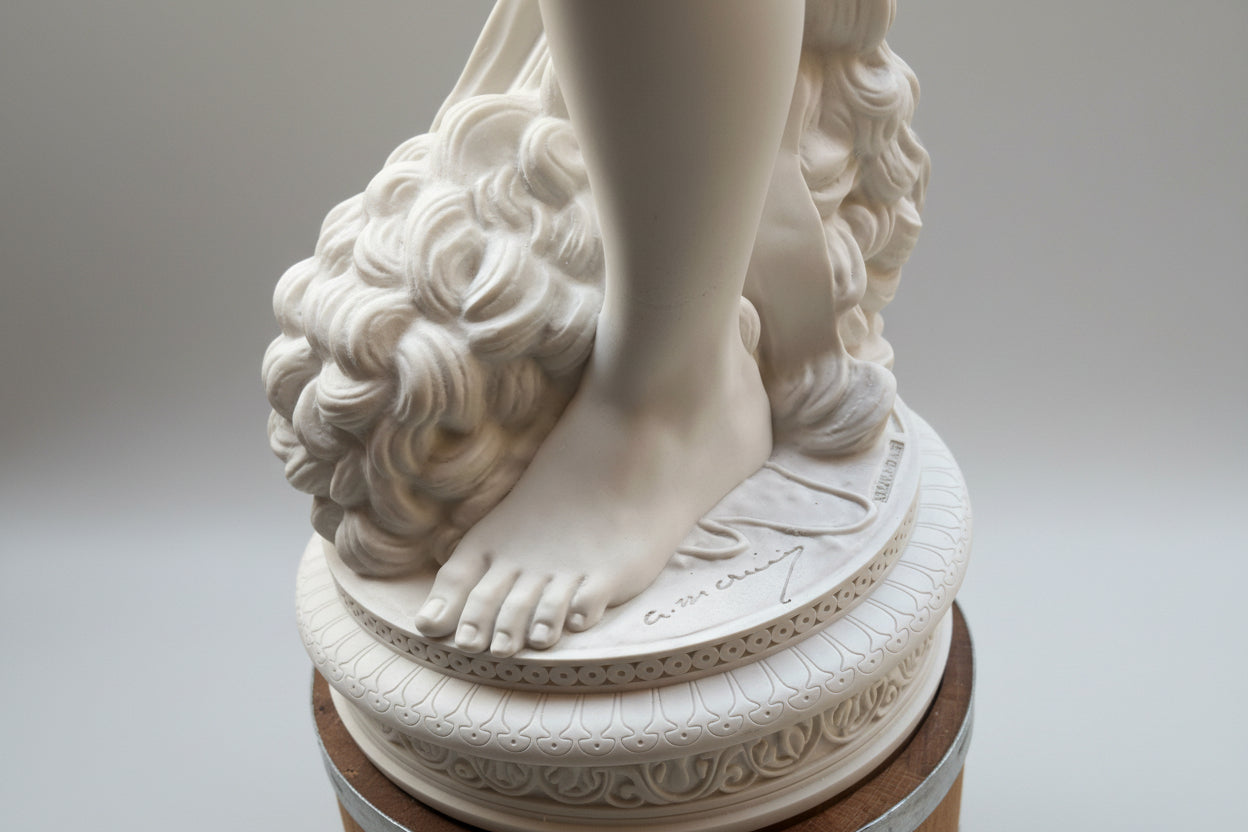
- Design & Composition: The statue highlights a dramatic contrast between the youthful David and the mature, bearded Goliath, whose head lies at David's feet on a decorated base. It is often described as possessing an elegant, confident pose.
- Symbolism: Emerging after France's 1870 defeat, the image of David defeating a giant served as a powerful allegory for the nation's hoped-for resurgence against Prussia.
- Production & Versions: The original plaster was created in 1869–1870. The French state commissioned bronze casts, with major examples located at the Museum D'Orsa, and the Musée des Augustins in Toulouse.
- Now reproduced bu Sculptured Arts studio, England, in exquisite Carrara marble, with stunning detail through out, and finished holding a bronze metal sword blade.
- Size. 110 x 50 x 40cm